Your site-specific safety plan, written from your answers.
Your general contractor wants a plan before your crew can start. Answer plain questions about your crew and the job. SSSPfy writes the plan, puts the standard beside every requirement, and sends it to your contractor to accept. General contractors invite their subs and get every plan in one place.
Works on a phone or a computer. Your answers are saved as you go.
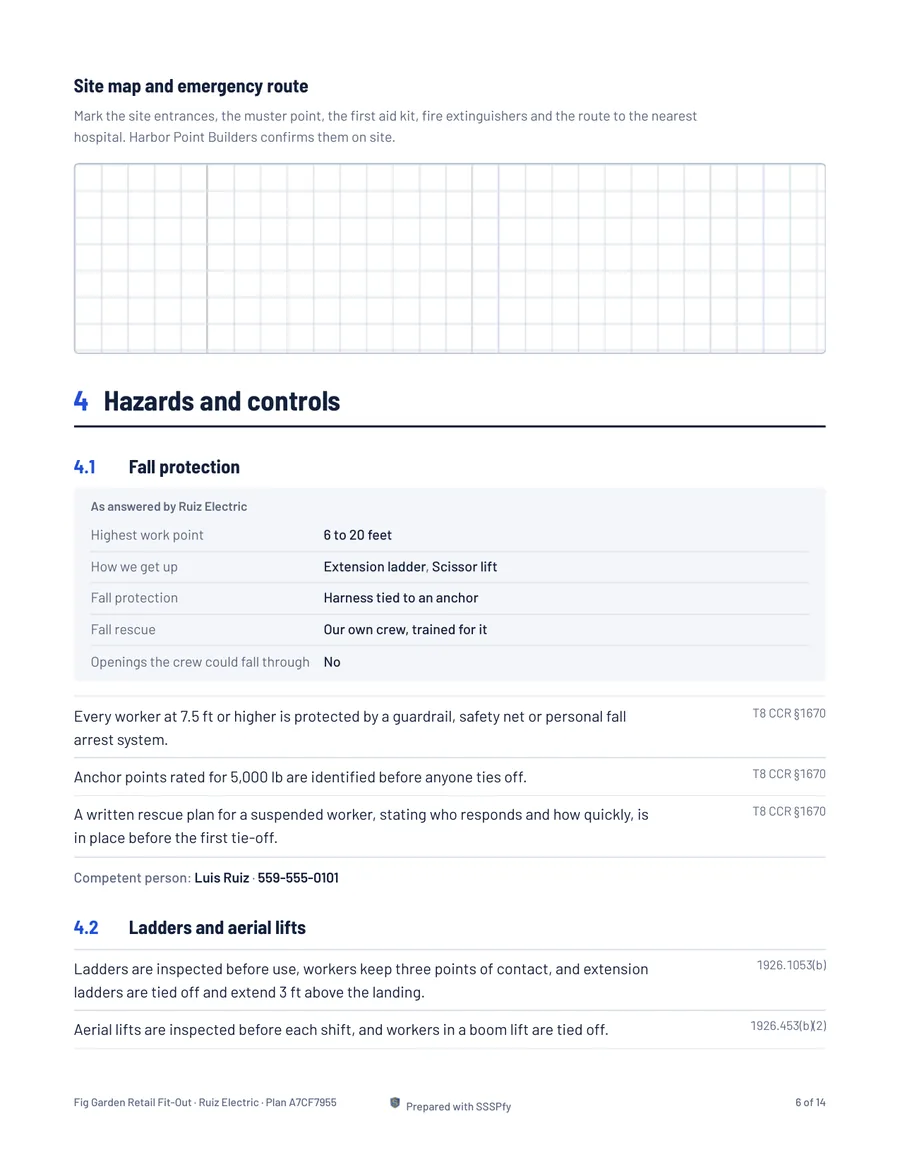
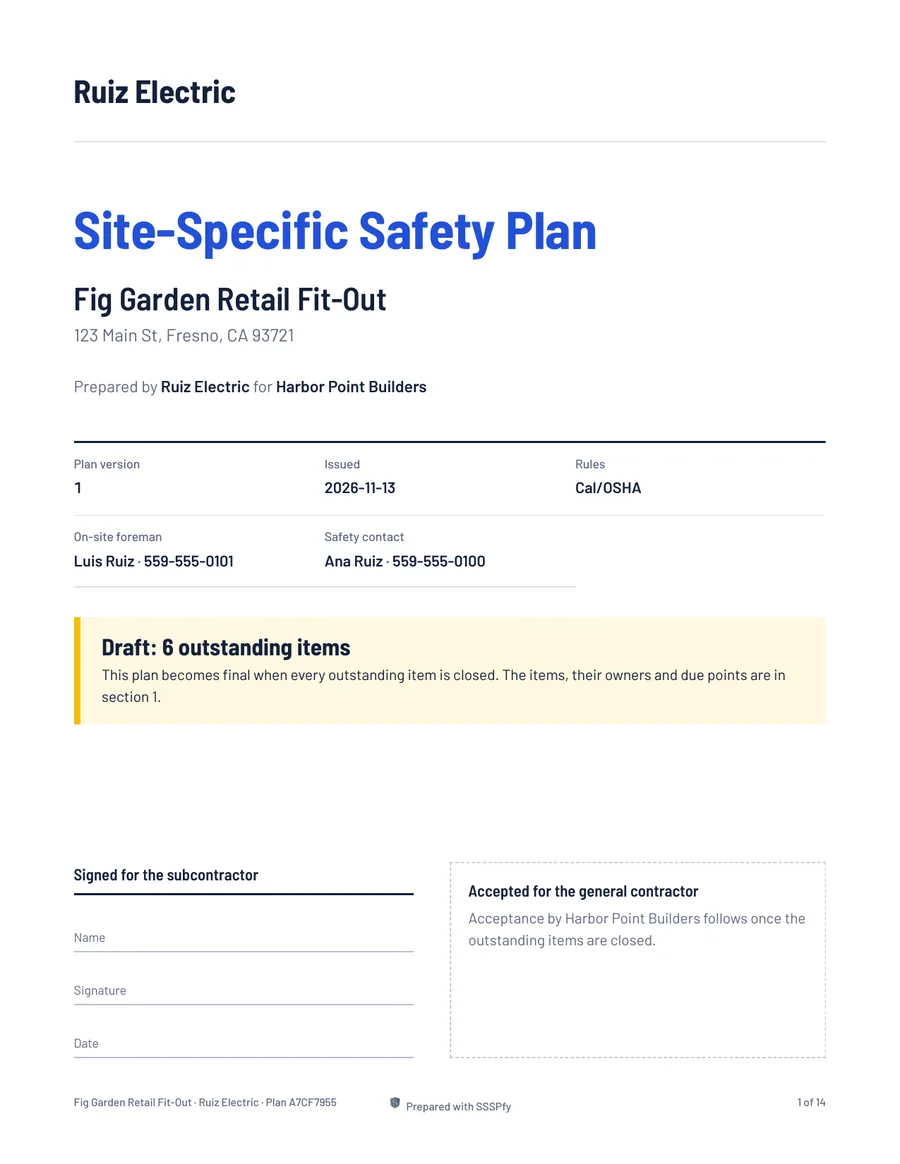
Every line traces to something you said.
Nothing in the plan is filler. Each hazard on your job gets one block like this one, built from your answers.
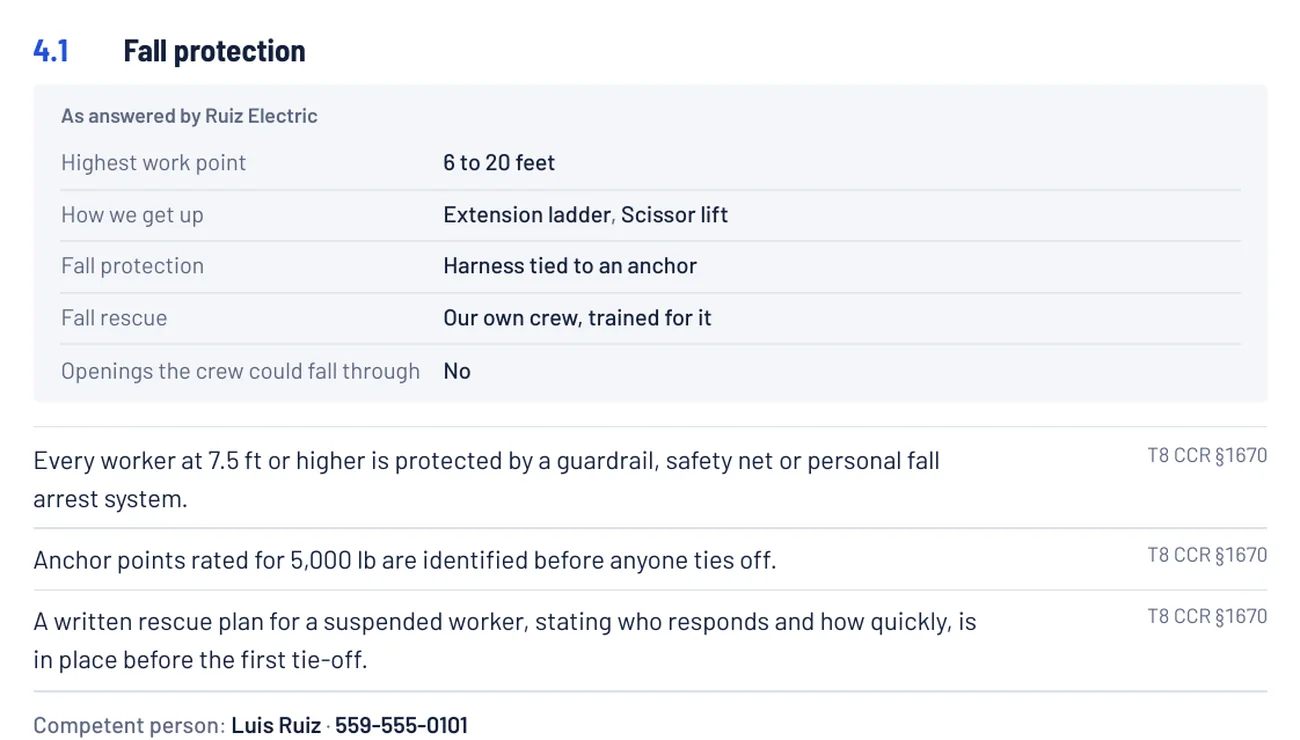
- What you answeredPrinted as you answered it, so your contractor sees what the plan is built on.
- The requirement that followsA full sentence that says who does what, with your company and your contractor named.
- The standard behind itThe OSHA section, or your state’s rule where the state runs its own plan, in the margin.
- The person responsibleYour competent person for that hazard, by name and phone number.
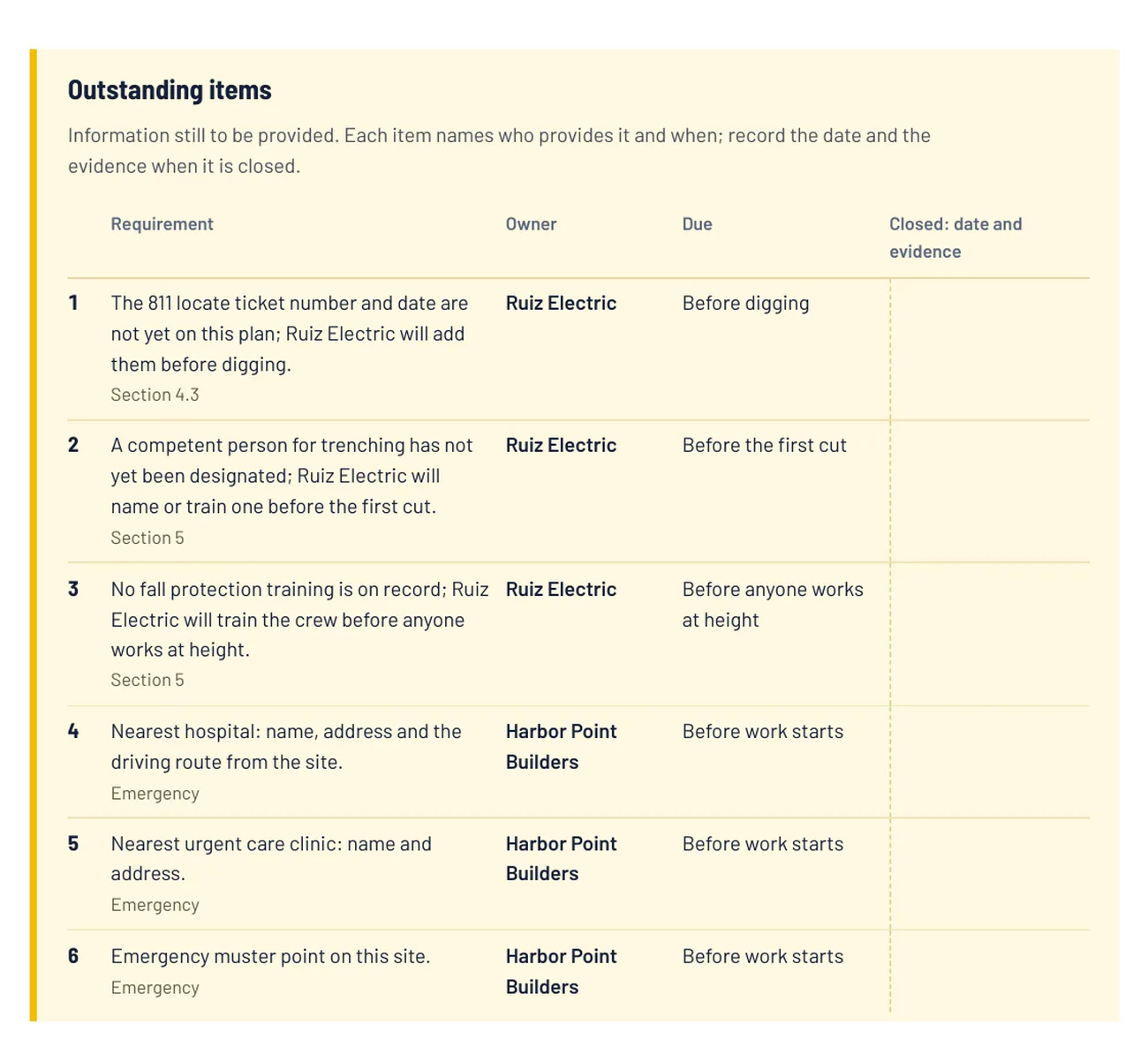
What you don’t know yet is printed, not hidden.
No 811 ticket yet? Nobody trained for the lift? The plan says so. Each gap becomes an outstanding item with an owner and a due point, and the cover says Draft until every item is closed.
Answers that disagree with each other are caught and listed the same way.
You close an item by typing the detail or the proof. Your contractor gives the nearest hospital and the muster point. When nothing is open, the plan is final and your contractor can accept it.
How it works
- 1
Answer the questions
One question on a screen, in plain words, about your company, your crew and this job. Only the trades and tasks you pick are asked about.
- 2
Get your plan
A PDF with your logo on the cover, numbered sections, an emergency page, and the forms your foreman uses on site.
- 3
Your contractor accepts it
Send it from the app. Your contractor accepts it or sends it back with notes. If the job changes, you send a numbered revision.
Also in every plan
- A daily pre-task plan, a toolbox talk sheet and an incident report, filled in with your job’s hazards.
- A day-one sheet in Spanish for the crew.
- A contents page, a revision history and a register of every standard the plan applies.
Trades covered today
Electrical, plumbing, structural steel and ironwork, concrete, heating, ventilation and air conditioning, roofing, carpentry and framing, excavation and sitework.